We’ve created this tracker to keep you up to date with all the latest developments in Employment and Immigration law – please bookmark it to make sure you don’t miss our latest posts. You can see what’s on the horizon at a glance by using the links below to see a summary of the current status of the latest developments.
Please note that this material has been published for informational purposes only and does not constitute legal advice. The information published was accurate as at 22 September 2026.
Employment Rights Act 2025
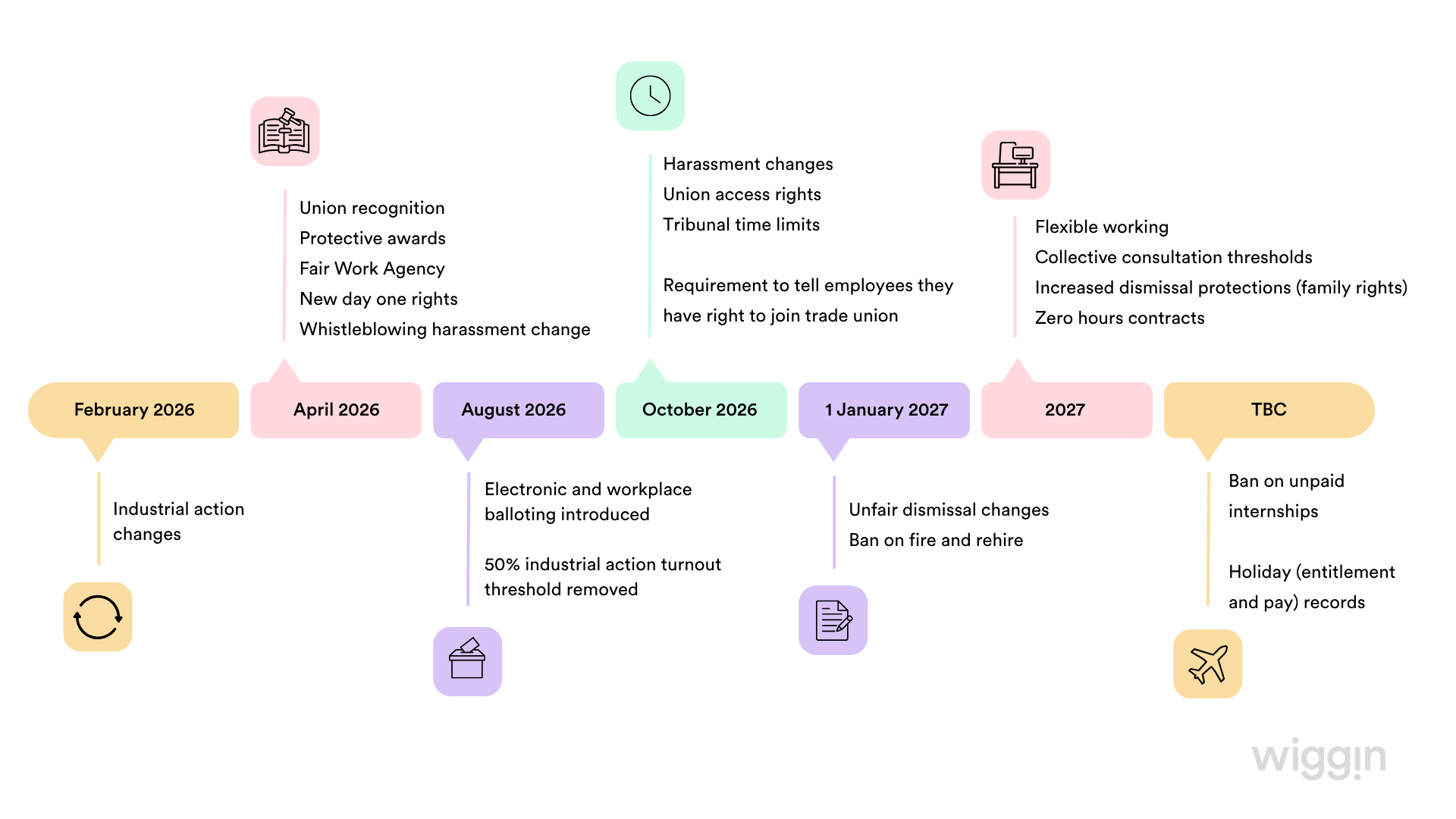
The Employment Rights Act 2025 marks the most ambitious overhaul of UK employment law since the Employment Rights Act 1996 came into force two decades ago. With reforms being phased in across 2026 and 2027, this will be less about reacting to a single legislative “big bang” and more about navigating a rolling programme of reform defined by preparation, policy change and operational recalibration. The most significant changes businesses should be aware of are summarised below.
Since February, the following changes apply:
- Employees are protected from unfair dismissal for taking part in industrial action for up to 12 months from the date the action begins
- The information requirements for ballot and voting papers have been simplified
- A successful ballot mandate now remains valid for 12 months (increased from the previous 6-month period)
- The minimum notice period for industrial action was reduced to 10 days (or 7 days where the employer agrees)
The government has published a fact sheet, available here.
Since April, the following changes apply:
- The maximum protective award increased from 90 to 180 days’ pay if an employer hasn’t complied with its collective consultation obligations
- Statutory sick pay is payable from the first qualifying day of absence for eligible employees and workers
- Sexual harassment is expressly listed as a qualifying disclosure under whistleblowing law
- Paternity leave and unpaid parental leave are now “day-one” rights (although paternity pay may still require a minimum number of weeks’ service)
- It’s now easier for trade unions to obtain recognition
- Employers must keep annual leave and holiday pay records for six years
- The Fair Work Agency was established as a single enforcement body for national minimum wage, holiday pay, statutory sick pay, employment agency standards and labour exploitation with powers to investigate, impose penalties, and initiate tribunal proceedings.
From 30 October, the following changes will apply:
- Employers must take all reasonable steps to prevent sexual harassment of their employees, and they will be liable for harassment by third parties
- The time limit for bringing tribunal claims will extend from three to six months
- Employers must inform employees and workers of their right to join a trade union
- Trade unions will have a legal right to enter workplaces and communicate with workers, so long as they follow a required process with the employer
- Other trade union changes will come into effect, including new rights for union representatives and protection against detriment for taking industrial action.
From 1 January, the following changes will apply:
- The qualifying period for unfair dismissal protection will be reduced from 2 years to 6 months. This means employers will need a fair reason and a fair process to dismiss any employee with at least 6 months’ service. In practice, this will apply to anyone employed from 1 July 2026 onwards
- The current cap on unfair dismissal compensation – the lower of 52 weeks’ gross pay or £123,543 – will be removed entirely, meaning there will be no statutory limit on the compensatory award a tribunal can make for unfair dismissal
- “Firing and rehiring” an employee in order to impose changes to key contractual terms (including pay, hours, pensions, shift patterns, and time-off rights) will be automatically unfair, unless the employer faces genuine financial collapse and the change could not reasonably have been avoided. Exemptions to this rule include TUPE-related dismissals and those attributable to a reduction in work.
Further down the line and dates to be confirmed:
- Employers who refuse a flexible working request will be required to provide written reasons and will only be able to refuse where this is reasonable in the circumstances
- Employers with 250 or more employees will be required to publish equality action plans setting out how they intend to close the gender pay gap and support employees through the menopause, with penalties for non-compliance
- Any confidentiality clause that prevents a worker from discussing acts of harassment or discrimination, including how their employer handled such allegations, will be void. This may be extended to cover specified non-workers, such as independent contractors and trainees, with limited exceptions to be set by future regulations
- Zero hours, low hours and similar workers will gain new rights to guaranteed hours reflecting hours worked over a reference period, reasonable notice of shifts and changes, and payment where shifts are cancelled, curtailed or moved at short notice. The detail of these rights is subject to ongoing consultation and will be set out in future regulations.
Other Key Legislation
Other important legislative developments aside from the Employment Rights Act 2025 include the following.
As a result of the Employment Tribunals (Early Conciliation: Exemptions and Rules of Procedure) (Amendment) Regulations 2025, the ACAS early conciliation period has been extended. Previously, parties had a six-week period from the point at which ACAS was notified of a claim to conciliate. The new regulations have doubled this conciliation period to twelve weeks.
Date of entry into force: 1 December 2025.
The Paternity Leave (Bereavement) Act received Royal Assent on 24 May 2024, and the Bereaved Partner’s Paternity Leave Regulations 2026 introduced the supporting secondary legislation. The Act makes provisions about paternity leave in cases where a mother, or a person with whom a child is placed or expected to be placed for adoption, dies.
Employees with responsibility for bringing up a child have a day-one right to up to 52 weeks’ bereaved partner’s paternity leave where the child’s mother/birth parent, primary adopter, or (in surrogacy cases) intended parent, dies within the child’s first year. Leave must generally be taken as a single continuous block within 52 weeks of birth, placement and entry to Great Britain for overseas adoptions, and is usually unpaid, unless employer policy provides otherwise. The notice requirements for taking leave differ depending on whether the death occurs less than 8 weeks or more than 8 weeks after the birth. During leave, employees are protected against dismissal and detriment, benefit from enhanced redundancy protection (including priority for suitable alternative vacancies), continue to accrue holiday, and retain the right to return to the same job or a suitable alternative.
Date of entry into force: 6 April 2026.
Announced in the King’s Speech 2024, the draft Equality (Race and Disability) Bill aims to introduce a statutory right to equal pay for ethnic minorities and disabled people – making it easier to challenge pay disparities due to ethnicity or disability – and introduce mandatory ethnicity and disability pay gap reporting, mirroring the existing gender pay gap reporting framework, requiring employers with 250 or more employees to disclose pay gaps related to ethnicity and disability.
Date of entry into force: TBC. On 25 March 2026, the government published its consultation response confirming that, following overwhelming support, mandatory ethnicity and disability pay gap reporting will be introduced for employers with 250 or more employees (mirroring the threshold for equality and menopause action plans). No timetable has yet been announced.
On 26 November 2025, the Labour government published a working paper on reform of non-compete clauses in employment contracts, setting out options including a total ban, a financial threshold limiting enforceability to higher earners and a statutory cap on duration.
The CMA responded on 25 February 2026, recognising the importance of labour market mobility for competition and economic growth. While acknowledging that restrictive covenants serve legitimate purposes – promoting investment in training, developing client relationships, and protecting confidential information – it views non-competes as a blunt tool. It noted that more targeted mechanisms (such as non-disclosure agreements, claw-back provisions and garden leave) may be less restrictive of labour mobility.
The CMA favours the combined approach set out in the DBT working paper, involving:
- a total ban on non-competes below a defined salary threshold; and
- restricting the duration of non-competes above this threshold.
A duration limit alone (such as the proposed three-month cap) was considered insufficient, particularly for lower-paid employees or those unable to afford unpaid periods between jobs. Equally, a blanket ban would not be appropriate, as non-competes remain more justifiable for senior roles.
Date of entry into force: TBC. However, given that part of the CMA’s function is to advise the government on competition law policy, its response is likely to carry considerable weight.
Cases to Watch
Beyond legislation, case law significantly influences how the law operates in practice. Key employment cases and judgments to monitor are set out below.
Rice v Wicked Vision Ltd [2025] EWCA Civ 1466
Claims: Whether employees dismissed for whistleblowing can bring a whistleblowing detriment claim where the alleged detriment is the dismissal itself, as well as an automatic unfair dismissal claim.
Background: The joined appeals in Rice v Wicked Vision Ltd and Barton Turns Developments Ltd v Treadwell concern employees who alleged that they had been dismissed because they had made protected disclosures. They sought to bring both a whistleblowing detriment claim under section 47B ERA 1996 and an automatic unfair dismissal claim under section 103A ERA 1996, relying on Timis v Osipov to pursue dismissal-related detriment claims through the co-worker and employer vicarious liability route.
Decision: The Court of Appeal held that, although it disagreed with the reasoning in Osipov, it was bound by that decision and therefore employees may, for now, bring whistleblowing detriment claims where the alleged detriment is dismissal. The Court confirmed that such claims may proceed against employers on a vicarious liability basis for the acts of co-workers involved in the dismissal decision. Permission to appeal to the Supreme Court has been granted, and the Supreme Court considered on 21 May 2026 whether section 47B(2) prevents such claims and whether Osipov was correctly decided.
Takeaway: This will be a significant decision for employers, as claimants can currently pursue twin track whistleblowing claims arising from the same dismissal, even though there is considerable debate on whether this was ever the purpose of the legislation. The detriment route is important because it may offer a lower causation threshold and access to injury to feelings compensation. Employers should monitor the Supreme Court decision once it is handed down to see if claims can still be defended on these twin tracks, and in the meantime review whistleblowing and dismissal processes, train managers involved in dismissal decisions and ensure decision-making is carefully documented.
Equity v Talent Systems Europe Ltd (t/a Spotlight) [2025] EWHC 2254 (KB)
Claims: Ruling of an employment agency under the Employment Agencies Act 1973.
Background: Spotlight has operated as a talent directory at the heart of the UK entertainment industry for nearly a century, initially publishing hard copy directories of entertainment performers and now operating an online directory where performers publish information about themselves (headshots, career highlights, skills, etc) which can be accessed by casting directors. Despite a long and previously positive relationship with the trade union Equity, in summer 2024, Equity and members of its counsel brought proceedings claiming that Spotlight operated as an employment agency under the Employment Agencies Act 1973, on the basis that Spotlight was in the business of providing services for the purpose of finding persons employment with employers or supplying employers with persons for employment by them. Had this claim succeeded, it would have resulted in commercial and regulatory implications for Spotlight’s business, despite the fact that it had operated in a consistent, unchallenged and reputable way for almost 100 years.
Decision: The High Court overwhelmingly found in Spotlight’s favour, with Equity’s claim being dismissed on all fronts. The judge ruled that Spotlight’s directory is “a number of steps away from a service for the purpose of finding persons employment” and instead serves as a marketing tool for performers to promote themselves to casting directors and other hirers. The case is now due to float in the Court of Appeal on 24 or 25 November 2026.
Takeaway: The case confirms that a platform which enables performers to market themselves to potential hirers does not constitute an employment agency simply because it facilitates connections between talent and casting directors. This is a significant result for SaaS platforms and talent directories operating in the entertainment industry, though the appeal means the position is not yet finally settled.
Pal v Accenture (UK) Ltd [2026] EAT 12
Claims: Unfair dismissal and disability discrimination under a progression-based performance model.
Background: Ms Pal was employed by Accenture as a manager for approximately ten years. Accenture operates an “up or elsewhere” model, under which employees who do not demonstrate readiness for promotion within a reasonable timeframe are deemed to be underperforming. Following a diagnosis of endometriosis, surgery, and two periods of sickness absence, Ms Pal received two consecutive “not progressing” ratings and was dismissed in July 2019 for performance reasons. The Employment Tribunal found the dismissal was procedurally unfair because Accenture breached its own disciplinary and appeals policy (i.e. failing to conduct an independent investigation and using previously involved managers as decision-makers) but nonetheless applied a 100% Polkey reduction and dismissed the disability discrimination claim.
Decision: The EAT allowed the appeal on all three grounds:
- The ET applied an incorrect counterfactual in its Polkey analysis – rather than asking what this employer would have done had it complied with its own policy, it hypothesised that the employer would have introduced a new policy for which there was no evidence.
- The EAT held that dismissal under an “up or elsewhere” model may not amount to the potentially fair reason of “capability”, because capability must be assessed by reference to the work the employee is contractually employed to do, not work they would do if promoted; it might instead constitute “some other substantial reason”.
- The ET’s analysis of whether the claimant was a disabled person was wholly inadequate, failing to engage properly with the medical evidence, the likelihood of recurrence, and the effect of the condition absent treatment. All matters were remitted to a differently constituted ET.
Takeaway: This case is significant for employers operating progression-based or “up or elsewhere” performance models. It clarifies that such models may not straightforwardly give rise to a “capability” reason for dismissal and highlights the importance of ensuring that dismissal procedures align with written policies. Employers should also take care to conduct a thorough and properly evidenced assessment of disability – particularly where conditions such as endometriosis involve recurring symptoms and surgical treatment – rather than relying on generalised credibility findings to dismiss an employee’s evidence. It is understood that an application has been made for permission to appeal to the Court of Appeal, though the grounds remain unclear at this stage.
Zen Internet Ltd v Mr Paul Stobart [2025] EAT 153
Claims: Unfair dismissal.
Background: Mr Stobart, the CEO of Zen Internet Ltd, was dismissed. The Employment Tribunal found that Zen had a potentially fair reason for dismissal – namely capability arising from poor performance – but that the dismissal was procedurally unfair because Zen had failed to follow a fair process. The ET also made a Polkey finding that Mr Stobart would have been fairly dismissed by no later than 31 May 2023 had a fair procedure been followed.
Decision: The EAT dismissed Zen’s appeal against the finding of unfair dismissal, holding that the ET had not imposed an absolute procedural checklist for capability dismissals and had directed itself correctly on the law. However, the EAT allowed the appeal in part on the Polkey assessment: the ET had wrongly confined its analysis to the period from 17 March 2023 onwards and failed adequately to explain why a fair dismissal would have occurred no later than 31 May 2023. That issue was remitted to the ET for reconsideration. The Court of Appeal has since granted permission to appeal, with the hearing expected to look at whether it was fair to dismiss Mr Stobart for incapability. Permission was granted because the EAT’s ruling raised a new legal point about the Polkey assessment: namely, that tribunals do not have to look forward only from a fixed date (such as the date of dismissal or the date notice was given) when predicting what would probably have happened if the employer had acted fairly, but they may also take into account what happened after the unfair treatment itself took place.
Takeaway: The case confirms that while there is no rigid procedural checklist that must be followed in every capability dismissal, particularly at senior executive level, employers must still demonstrate a fair process. On remedy, tribunals must provide clear reasoning for the date by which they find a fair dismissal would have occurred when conducting a Polkey analysis and must not artificially restrict the evidential window when making that assessment.
Immigration
There’s also plenty to watch out for on the immigration front – we’ve outlined the key developments to be aware of below.
As part of the Migration Advisory Committee’s self-commissioned review to assess how best the immigration system could be used to attract top talent to the UK, it launched a call for evidence on the Global Talent and Innovator Founder visa routes.
Deadline to respond: Consultation closed May 2026
Find out more here.
The government sought views on introducing a digital ID system. The system would enable secure access to public services and digitalise Right to Work checks. It would be free, optional, and accessible via smartphone or tablet. The government would like for digital ID to become central to the UK’s right to work regime although it will remain optional and access to public services will not be made dependent on having digital ID.
Deadline to respond: Consultation closed May 2026
Find out more here.
The Home Office’s draft revised Code of Practice on right to work checks makes three notable changes:
- It intends to extend coverage to workers, individual sub-contractors, gig economy and platform workers in line with the Border Security, Asylum and Immigration Act 2025.
- It requires employers to accommodate digital verification failures so individuals are not penalised.
- It reinforces that checks must be applied consistently, with no mandatory digital route save for eVisa holders.
Deadline to respond: Consultation closed April 2026
Find out more here.
On the Horizon
New Right to Work requirements
The UK’s Right to Work Scheme will be significantly expanded under section 48 of the Border Security, Asylum and Immigration Act 2025. Currently, employers must conduct right to work checks only on employees. The new regime extends this obligation to a much broader range of working relationships, including individual subcontractors, casual workers, those engaged through worker contracts, and individuals sourced via online matching platforms. The draft updated guide can be found here (make sure to click on the first pdf link titled “16 July 2026”), which if implemented in full, will come into force on 1 October 2026.
Liability may extend even where work is delegated or subcontracted. Sectors reliant on flexible or outsourced labour models – such as daily crew in Film & TV, agency hires in sports and offshore hires in betting and gaming organisations – are expected to face the greatest operational impact.
Date of entry into force: 1 October 2026.
Earned settlement proposals
The government’s “earned settlement” proposals represent a fundamental shift in the criteria for obtaining indefinite leave to remain, moving from a system based primarily on time spent in the UK to one centred on contribution. Under the current system, most economic migrants qualify for settlement after five years of continuous residence. The proposed model would double the baseline qualifying period to ten years, with adjustments increasing or decreasing this period based on individual contribution.
Key criteria include minimum annual earnings of £12,570 for three to five years, enhanced English language proficiency at B2 level, and no criminal convictions. Mid earners and high earners, i.e. those earning above £50,270 and £125,140 per year respectively, could qualify in as few as five or three years, whilst lower paid workers – particularly those on lower-skilled occupations – may face qualifying periods of up to fifteen years.
Significantly, dependants will need to qualify in their own right rather than alongside the main applicant, a requirement that could have a material impact on families considering long-term settlement in the UK. The proposals are intended to apply retroactively to those already in the UK but not yet settled, although this is yet to be confirmed.
Date of entry into force: TBC
Helpful Resources
National Minimum Wage
| 16-17 and apprentices | £8 per hour |
| 18-20 | £10.85 per hour |
| 21 and over | £12.71 per hour |
| Accommodation offset | £11.10 per day or £77.70 per week |
Weekly rate
| Statutory Sick Pay | £123.85 or 80% average weekly earnings, whichever is lower |
| Statutory maternity, paternity, adoption, shared parental, neonatal and parental bereavement pay | £194.32 |
| Statutory redundancy cap | £751 (£783 in Northern Ireland) |
ACAS website
EHRC website (particularly sexual harassment technical guidance here and here) and the Code of Practice for services, public functions and associations 2026 following the decision in For Women Scotland Ltd v The Scottish Ministers [2025] UKSC 16
Equality Action Plan guidance and list of actions
Our employment and immigration lawyers will continue to track developments closely. We will issue further updates as implementation plans are announced and highlight where we think the changes may have a particular impact on the media, technology and sports sectors. In the meantime, our specialists are here to help if you have any questions.